Stocked Parts
We carry torsion springs sized for the taller, heavier commercial sections common in buildings from Bellevue's era - 1930s through 1950s construction tends to run wider bays than newer light-commercial builds, and a spring sized for a residential double door won't hold that weight safely.
We stock rollers and track sections rated for the severe cold this region sits in, which matters here specifically because unheated bays cycle through freeze-thaw more than a climate-controlled space would, and that's what fatigues galvanized track fastest. We also carry weatherstrip and bottom seal profiles sized for the older, narrower track gauge still found on doors from that build window - a newer stock seal often won't seat right on it.
What we don't stock: obsolete panel profiles matched to a specific 1950s manufacturer. If a section's dented and the run is discontinued, we'll tell you straight that patch-matching isn't realistic and a full panel replacement or door swap is the honest fix, even if that's not the answer you were hoping for.
Booking a Visit
We run out of Pittsburgh, about six miles from Bellevue. There's no branch or depot on this side of the river - the truck comes to you, loaded for the job based on what you describe when you call.
Because Bellevue is a small base of roughly 4,127 households, we don't have a standing crew stationed here the way a bigger suburb might get. That means giving us as much detail as you can up front - door size, approximate age of the building, whether it's a spring, opener, or track problem - helps us load the right parts before we leave rather than making a second trip.
We book commercial calls the same way as residential ones: by phone, with a description of the symptom, not an online slot picker guessing at your door type.
What You Are Seeing
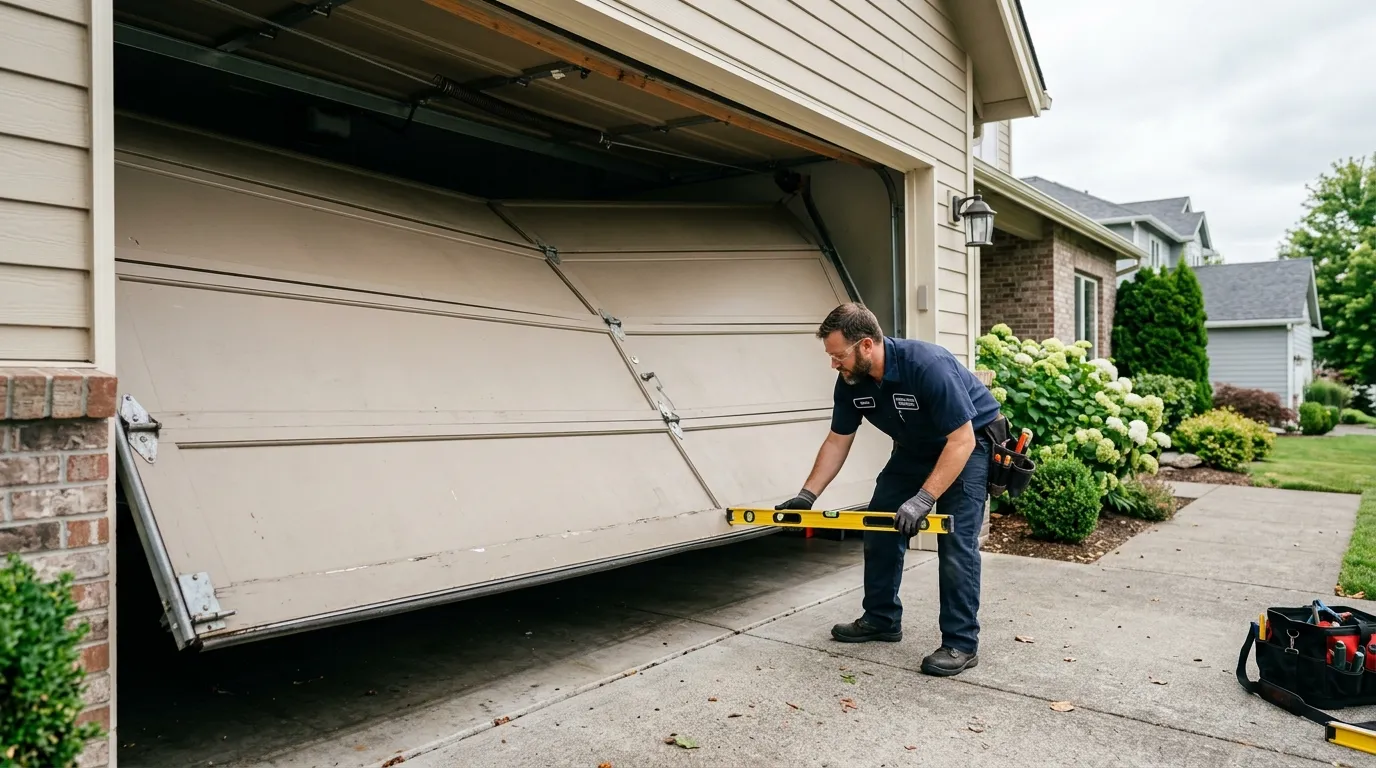
If the door's dragging on one side going up, or the roller's visibly chewed and shedding rubber, that's usually the track out of true - common on a building this age where the jamb itself has settled over decades.
If the door won't budge and the opener's straining or clicking without movement, that's very likely a broken torsion spring, and on an older commercial door that's not a job to force by hand - the section is heavier than it looks and the spring's still under tension even broken.
A door that closes unevenly, dropping faster on one end, points to a cable that's frayed or jumped its drum. That's common where the door cycles heavily and the cable's original to a mid-century install.
Buzzing or grinding from the opener with the door barely moving usually means the opener's fighting worn hardware rather than the opener itself being the problem - replacing the opener without fixing the track underneath just repeats the failure.