24/7 Emergency Service Open 7 days · 7am–8pm Serving Pittsburgh, PA & nearby
(412) 674-9419
Pittsburgh, PA

Garage Doors on Pittsburgh's Pre-Insulation Housing Stock

Pittsburgh homes mostly date pre-1960, built before modern insulation codes existed, and our cold winters push those old seals and doors even harder.

Garage Doors on Pittsburgh's Pre-Insulation Housing Stock

What Local Conditions Do

Pittsburgh's housing runs from 1938 up through 2014, but the median build year sits at 1955, and most of the stock across the 108 named areas around the city is pre-1960. That matters for garage doors more than people expect. A door built or replaced to match a 1950s house was never designed against a modern energy code - there was no code yet. In neighborhoods like the Hill District, Beechview, Carrick, and Brookline, you still find original openings sized for doors that predate foam-core panels entirely, sometimes with jamb framing that's shifted an inch or more over seventy years.

On top of the age of the housing, the region sits in a cold, severe climate band. That combination - old openings plus real winter - is what actually drives the work. A door that's merely old in a mild climate can coast for decades. A door that's old here takes freeze-thaw cycling at the bottom seal, condensation inside an uninsulated steel skin, and a slab that's heaved slightly out of level from decades of frost. None of that is a defect in the door. It's what happens when 1950s hardware meets a Pittsburgh winter for seventy-some years straight.

The Cost of This Job

We don't have a number to hand you here without looking at the door, and that's the honest answer rather than a placeholder. What we can tell you is what drives the estimate on a house from this era: whether the original opening is a standard size or was framed oddly for a door that no longer exists on the market, whether the track is side-mounted (common on older one-piece and early sectional installs) versus the low-headroom torsion setups builders use now, and whether the jamb itself needs squaring before a new door will seal at all.

Houses built before insulation rules typically have zero R-value in the door itself, so replacing that door is often the single biggest thermal upgrade you can make to a garage in one job - bigger than adding a heater, in a lot of cases. That's a factor worth weighing against a straight repair. If the panels are original steel with no foam core, patch work on a cracked panel is rarely worth doing twice; at some point the door itself is the maintenance problem, not the springs or the opener. We won't quote you a repair on a door we think you'll be replacing again in two winters.

Doing Nothing For Now

Across the service area there are roughly 279,154 households, and about 155,574 of those are owner-occupied houses - most of them built in the same pre-1960 window as the rest of the regional stock. A lot of those garages get treated as storage first and shelter second, so a door that's slow, drafty, or hard to close doesn't always feel urgent. In a cold, severe climate, though, waiting has a cost that shows up in ways other than the door itself: a bottom seal that's failed lets meltwater track back under the slab and refreeze against the foundation, and a panel that's racked from years of an unbalanced spring puts more load on the opener motor every single cycle through the winter.

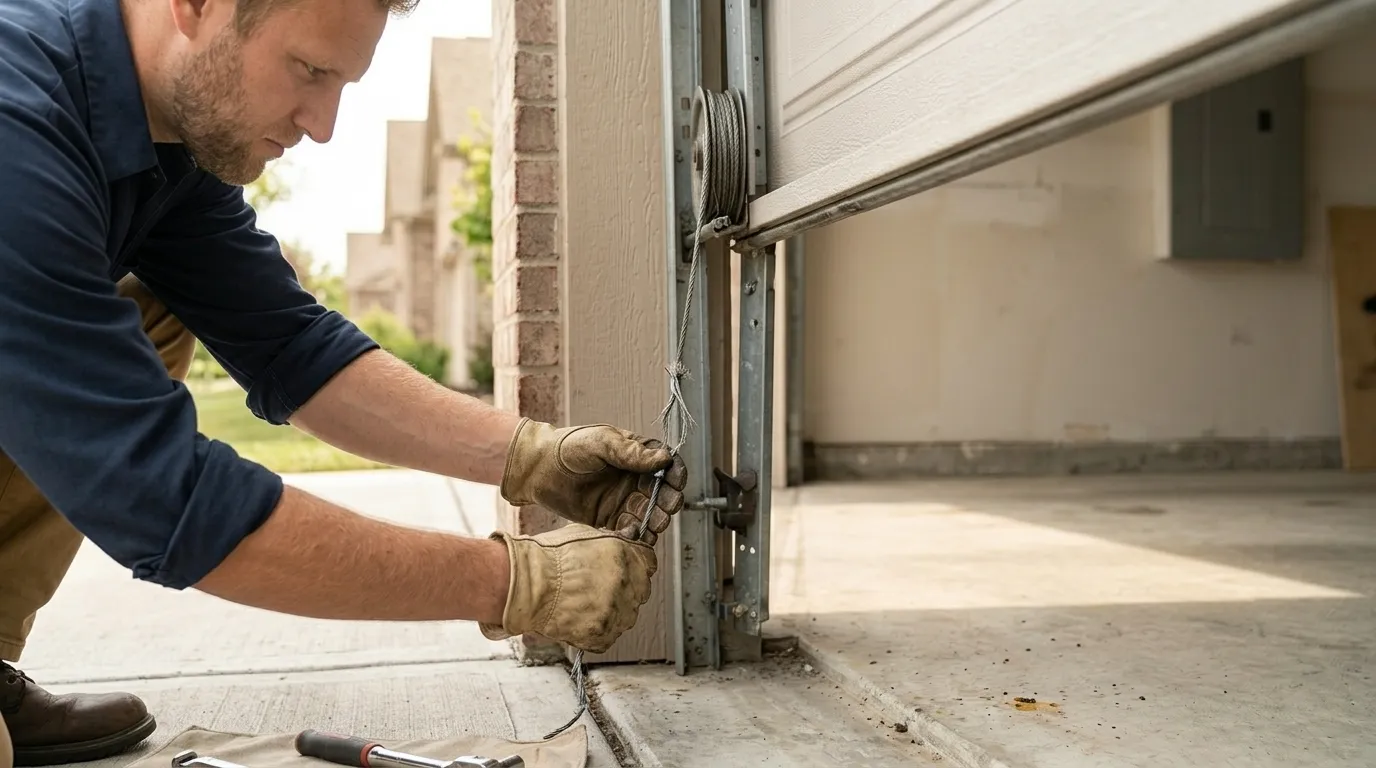
We're not going to tell you every worn seal is an emergency - it isn't. A door that closes slow but seals fine can often wait a season. What can't wait is a spring that's already showing rust-through or a cable that's frayed at the drum, because on an older door with original hardware, that's the failure that takes a section of panel with it when it lets go.
The Problem

"Doors on houses built before insulation rules" is a specific category, not a general complaint about old doors. It means a door installed when the opening was cut to a builder's spec from 1950 or so, with a single layer of steel or a wood panel, no thermal break at the frame, and weatherstripping that was an afterthought rather than a code requirement. Over the decades since, most of those original doors have been swapped at least once, but the opening and jamb are often still the 1950s originals - which is why a modern door bought off the shelf sometimes doesn't sit right until the frame is corrected.

The gap this leaves is at the edges: around the jamb, along the bottom astragal, and at the top panel where an old header wasn't built to hold a heavier insulated door. In a climate that runs cold and severe for months at a stretch, that's where the cold air gets in and where ice tends to form first. Fixing the door without addressing the opening it sits in just moves the same problem to a new panel.

How it works

From “it’s stuck” to “it’s fixed”

01
Tell us what’s wrong - Pittsburgh garage door service

Tell us what’s wrong

Describe the symptom - won’t open, loud bang, opener runs but the door won’t move.

02
On-site diagnosis - Pittsburgh garage door service

On-site diagnosis

A technician tests the door under power and by hand and finds what actually failed.

03
Clear, up-front plan - Pittsburgh garage door service

Clear, up-front plan

You get the fix that’s needed and what drives the cost - before any work starts.

04
Repaired & tested - Pittsburgh garage door service

Repaired & tested

The repair is done, the door is set true and tested, and the work area left clean.

Serving Pittsburgh, PA - tell us what your door’s doing and we’ll take it from there.

How we work

What to expect

Diagnosis firstEvery visit starts by finding what actually failed - not a pre-written parts list.
The right part for the doorSprings and openers matched to the door’s weight and age, so the fix holds up.
Straight answersWhen a repair makes more sense than a replacement - or the reverse - you hear it plainly.
Clean, careful workTension released safely, hardware set true, the door tested under power before we leave.
Questions

Frequently asked

Straight answers about garage door repair in Pittsburgh. Still unsure? Ask us directly.

Is my garage door actually from before insulation codes existed, or was it replaced at some point?

Hard to say without seeing it, but if your house dates to the 1950s stock common across this area and the door looks like a single flat steel or wood panel with no visible foam core, it's likely original or close to it. A foam-filled sectional door with a vinyl-backed panel is a later replacement, even in an older house.

Do I need to replace the whole opening, or just the door?

Depends on how far the jamb has shifted. Houses from the 1938-2014 range, especially the pre-1960 majority, sometimes have framing that's settled enough that a new standard-size door won't seal without correcting the jamb first. We check that before quoting a straight door swap.

Will a new insulated door actually make a difference in winter?

In a cold, severe climate, yes, more than most upgrades to a garage. An original pre-code door has effectively no R-value, so an insulated replacement cuts the temperature swing inside the garage noticeably, which also protects anything mounted on that wall, including the opener.

Ready to get your garage door sorted?

Tell us what it’s doing and where you are in Pittsburgh - we’ll take it from there.

Request a QuoteCall