Wind, Wide Doors, and Pittsburgh's Older Housing Stock
How Pittsburgh's cold-severe climate and pre-1960 housing stock combine to put extra stress on wide garage doors, and what that means for repair or replacement.
Pittsburgh sits in a cold-severe climate band, and that matters more for a wide door than most people think. A single-car opening flexes a little in wind. A double-wide door - the kind bolted onto a two-car garage - has almost twice the surface area catching the same gust, and it's the long horizontal panels and the center meeting rail that take the load first.
Across the service area, the housing stock runs mostly pre-1960, with a median build year of 1955, spread across 108 named neighborhoods from low ground near Homestead and Munhall to the ridges around Squirrel Hill and Fox Chapel. Elevation changes that sharp mean wind exposure isn't uniform block to block - a door that's fine on a sheltered street in Brookline can be doing real work on an exposed lot near Beechview or Carrick.
Older openings were often framed for a single door and later widened when the second bay got added. That means the jamb, the header, and the track anchoring weren't always built for the wider span they now carry. Wind doesn't cause that mismatch. It just finds it.
The Cost of This Job
I'm not going to put a number here that I can't back up - what a repair or reinforcement costs depends on the door's width, its current track and hardware, and what's behind the opening framing-wise, and none of that is something I can guess from a fact sheet. What I can tell you is what drives the cost up or down on a wide door specifically: whether the horizontal struts are already there or need adding, whether the track brackets are pulling from wood that's been in place since the house was built, and whether the opener has enough reserve capacity to handle a heavier reinforced panel.
With 155,574 owner-occupied houses across this service area, a lot of them still carry the original opening framed sometime between 1938 and 2014. On the older end of that range, the fix is often reinforcement plus hardware - not a full replacement. On a door that's already sagging or delaminating, replacement usually costs less over time than repeated patch repairs. An honest look at the door in person is the only way to know which side of that line you're on.
Doing Nothing For Now
A wide door that flexes in wind but still opens and closes doesn't feel urgent, and most winters here that's a fair read. But the failure pattern on a wide door isn't usually one big event - it's the track pulling a little further from the jamb each time the wind loads it, especially once the cold sets in and the wood or masonry it's anchored to contracts.
Wait through one full cold-severe season on a door that's already flexing, and the hardware wear compounds. Rollers ride rougher in the track, the opener works harder to pull a door that's not tracking true, and the panel itself can start to bow permanently at the center rail. None of that shows up overnight. It shows up as a call that used to be a tightening job and is now a track-and-panel job.
Waiting isn't automatically wrong - a door with minor flex and solid anchoring can go years without trouble. The risk is assuming that's what you have without anyone looking at the anchoring itself.
The Problem
Here's the mechanism, plainly: a wide door has a long unsupported span between its side tracks. Wind pressure pushes on that span, and without enough horizontal reinforcement, the panel bows toward the inside of the garage. Do that enough times and the bow stops fully rebounding - the door holds a slight curve even at rest.
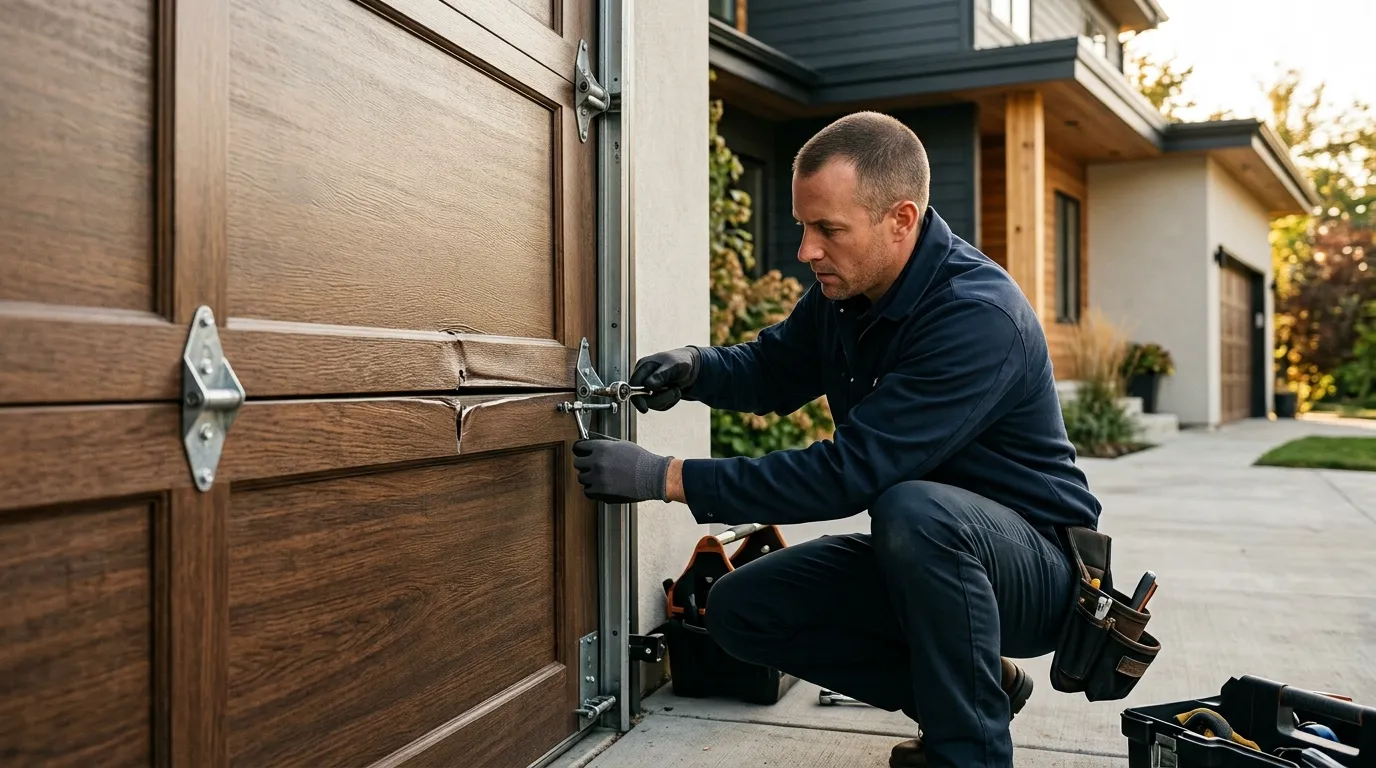
On the pre-1960 stock that makes up most of this area's housing, the openings were often framed narrower originally, and the header above a later-widened opening doesn't always carry the same margin the rest of the house was built with. So the track brackets - the hardware taking the wind load and passing it to the frame - are anchored into wood or masonry that's carrying more than it was sized for.
That's not a Pittsburgh-specific design flaw. It's what happens when a mid-century opening gets widened decades later without upgrading what holds the track. The wind doesn't create the weak point. It just tests it every time the weather comes through, which in a cold-severe climate is often.
How it works
From “it’s stuck” to “it’s fixed”
01
Tell us what’s wrong
Describe the symptom - won’t open, loud bang, opener runs but the door won’t move.
02
On-site diagnosis
A technician tests the door under power and by hand and finds what actually failed.
03
Clear, up-front plan
You get the fix that’s needed and what drives the cost - before any work starts.
04
Repaired & tested
The repair is done, the door is set true and tested, and the work area left clean.
Serving Pittsburgh, PA - tell us what your door’s doing and we’ll take it from there.
Why does my garage door shake more on windy days than it used to?
Usually it's the track hardware, not the panel itself. As anchors work loose over years of wind load and freeze-thaw cycling, the door has more play side to side, so it shakes and rattles even under wind that wouldn't have moved it when the anchoring was tight. Tightening or replacing the brackets often solves it without touching the panel.
Is a wide double door always weaker than two single doors?
Structurally, yes, by design - a double-wide opening spans further, so the door needs horizontal struts to resist bowing that a single door doesn't need. It's not a defect, it just means the reinforcement has to be there and has to be anchored into framing that can hold it, which isn't always the case on an opening that was widened after the house was originally built.
Can I just add reinforcement struts myself?
You can buy strut kits, but the strut only helps if the track and jamb anchoring behind it can take the added load transfer. On a lot of the pre-1960 openings around here, that anchoring is the actual weak point, not the panel - so a strut without checking the hardware behind it can mask a problem instead of fixing it.
Ready to get your garage door sorted?
Tell us what it’s doing and where you are in Pittsburgh - we’ll take it from there.