24/7 Emergency Service Open 7 days · 7am–8pm Serving Pittsburgh, PA & nearby
(412) 674-9419
Pittsburgh, PA

When a Spring Goes in Cold Weather

Pittsburgh's pre-1960 housing stock and severe cold winters are a hard combination for old torsion springs. Here's what actually happens and what it takes to fix it.

When a Spring Goes in Cold Weather

What Local Conditions Do

Pittsburgh sits in a climate band rated cold and severe, and that matters more for your garage door than most people realize. A torsion spring is just wound steel under tension, and steel behaves differently as it gets cold. It loses flex, the metal fatigues faster at the coil bends, and a spring that had another season left in a mild fall can snap on the first hard freeze of the year. This isn't a defect in the spring - it's physics meeting age.

What makes this town a particular problem is the housing behind those doors. Homes here run from 1938 to as recent as 2014, but the median build year is 1955, and across the 108 named areas we cover - from the Hill District down through Squirrel Hill, Beechview, and out to Homestead and Baldwin - the pattern holds: mostly pre-1960 construction. A lot of those garages still have the original torsion setup, sometimes decades past its expected cycle count, sitting in an unheated space that swings hard with the outside temperature. Add a severe cold snap and you get the call we hear most in January and February: a bang from the garage, then a door that won't move.

The Cost of This Job

We're not going to quote you a number here, because a torsion spring job on a 1955 door isn't priced the same as one on a 2010 build, and guessing at it does you no favors. What actually drives the cost is the door itself: how many springs it needs, the wire size and wind of the original spring, and whether the drum and cable are original or already replaced once.

Older doors - and given the median build year of 1955 across this area, a lot of the ones we see are older - sometimes use spring sizes and mounting hardware that aren't common stock anymore. That can mean a slightly longer job while the right part gets sourced, versus a same-day swap on a newer door with a standard torsion size. It's worth knowing going in, rather than being surprised by it. If your door was replaced more recently, you're usually looking at a simpler, faster job because the hardware is current.

The honest limitation here: we don't keep every obsolete spring size on the truck. If your house dates to the earlier end of that 1938 start point, there's a real chance we need a day to get the exact part.

Doing Nothing For Now

A broken spring on a double door doesn't always look like an emergency. The door might still lift a little with the opener straining, or it might sit stuck halfway, and it's tempting to just leave it until the weather warms up. Don't. With no spring counterbalancing the weight, the opener is now doing a job it was never built for, and on older doors - the kind common across this area's pre-1960 stock - that strain finds the weakest point fast, usually the drum, the cable, or the opener's drive gear.

There's also the manual angle. A double garage door without spring tension weighs enough that trying to force it open by hand is a real way to hurt yourself or drop the door on something, or someone, underneath it. If the spring lets go while the door is in motion, that risk goes up.

Waiting a week rarely turns a spring replacement into something bigger. Waiting through a whole cold season on a door with hardware that's already fifty-plus years old is a different bet, and it's not one we'd recommend across a service area where owner-occupied houses number 155,574 and a meaningful share of them are running original garage hardware.
The Problem

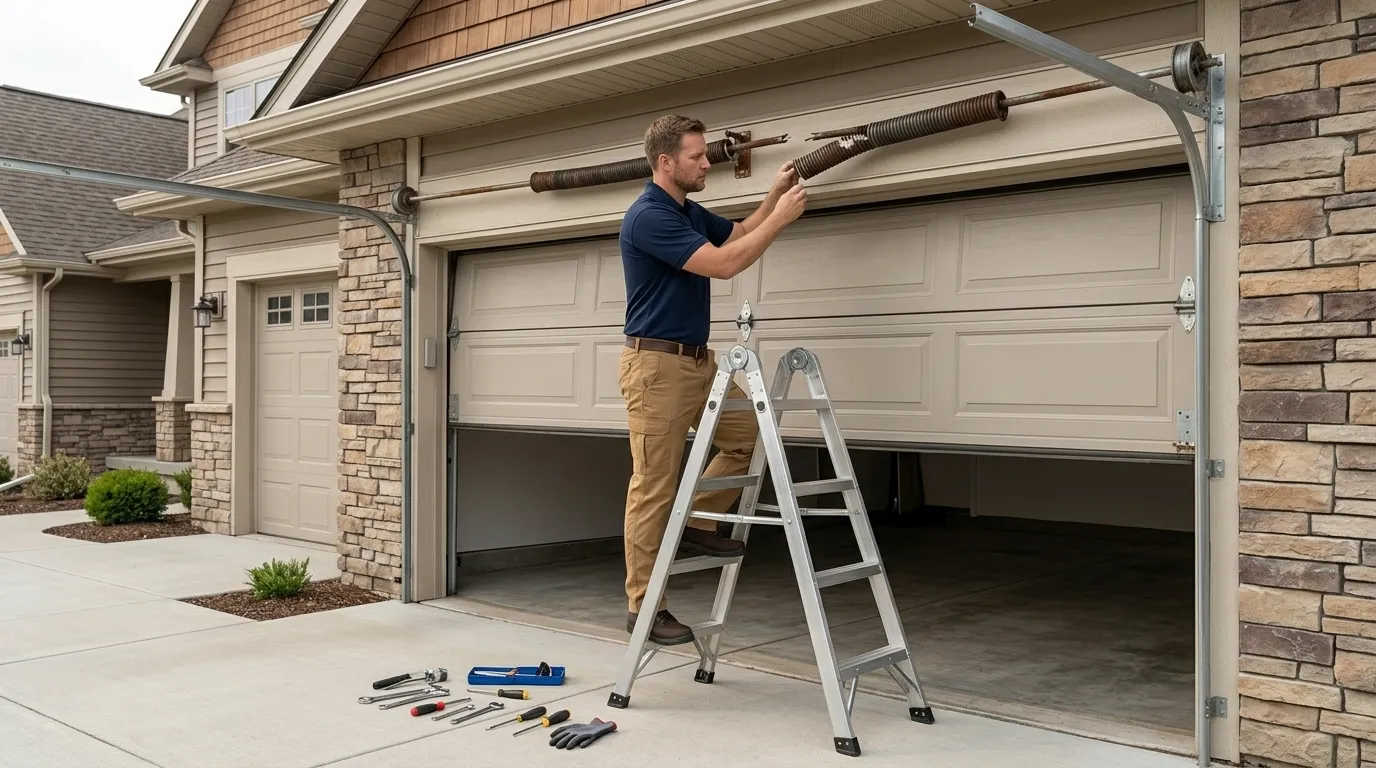
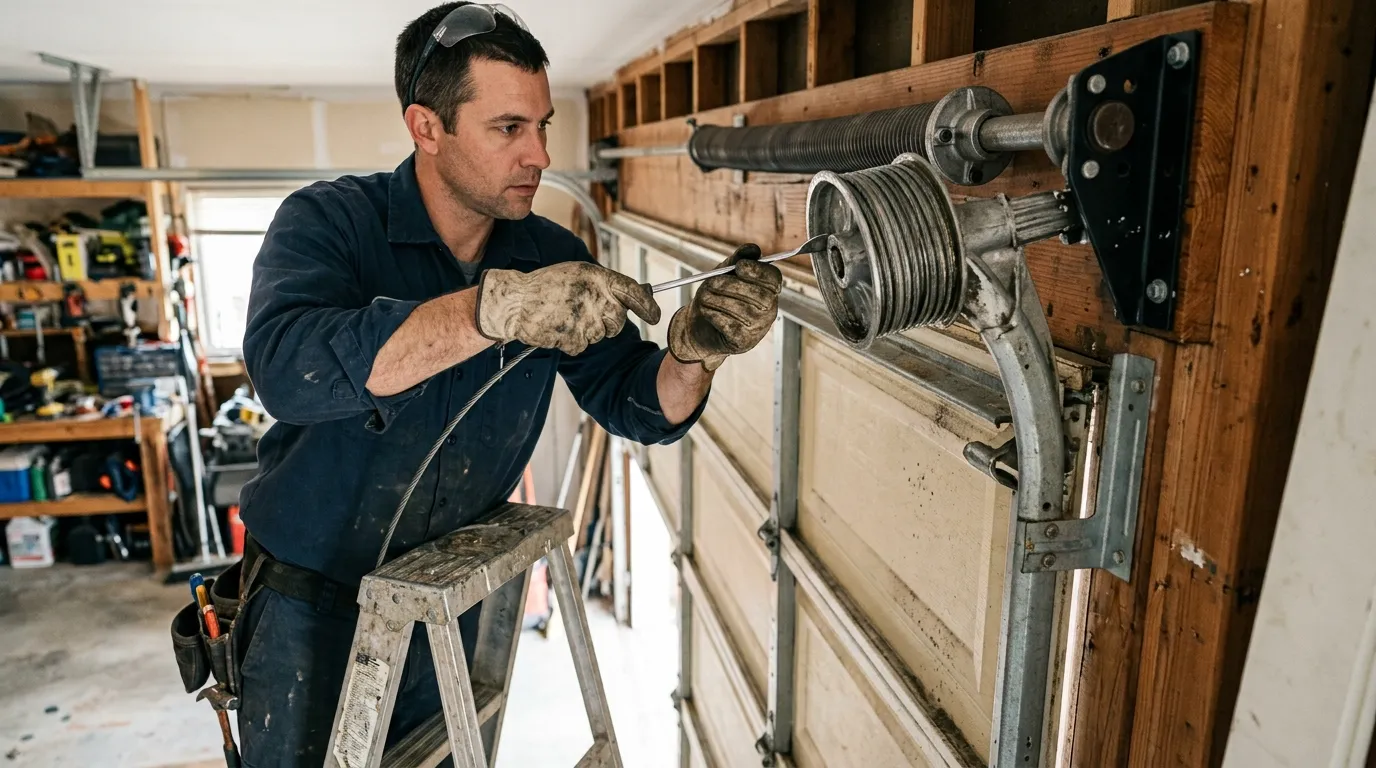
Here's the mechanism, plainly: torsion springs store energy by twisting steel wire around a shaft, and every open-and-close cycle flexes that wire slightly. Over years, micro-fractures build up inside the coil. In warm weather the steel still has enough give to absorb that stress. In a severe cold snap, it doesn't - the metal contracts, gets brittle at the coil bends, and the next cycle is the one that breaks it.

This is why the call volume spikes here specifically when temperatures drop hard, not gradually. It's also why the age of the door matters more than almost anything else. A spring installed on a house built near the 1955 median for this area has had close to seventy winters to accumulate that fatigue, cold snap by cold snap. A spring on a house from the 2014 end of the build range hasn't. Same climate, very different spring life left.

We see this across the whole footprint - Squirrel Hill, Brookline, Carrick, out toward Whitehall and Bethel Park - because the housing pattern repeats: older stock, unheated garages, and winters that stress-test old steel every year whether the door gets used or not.

How it works

From “it’s stuck” to “it’s fixed”

01
Tell us what’s wrong - Pittsburgh garage door service

Tell us what’s wrong

Describe the symptom - won’t open, loud bang, opener runs but the door won’t move.

02
On-site diagnosis - Pittsburgh garage door service

On-site diagnosis

A technician tests the door under power and by hand and finds what actually failed.

03
Clear, up-front plan - Pittsburgh garage door service

Clear, up-front plan

You get the fix that’s needed and what drives the cost - before any work starts.

04
Repaired & tested - Pittsburgh garage door service

Repaired & tested

The repair is done, the door is set true and tested, and the work area left clean.

Serving Pittsburgh, PA - tell us what your door’s doing and we’ll take it from there.

How we work

What to expect

Diagnosis firstEvery visit starts by finding what actually failed - not a pre-written parts list.
The right part for the doorSprings and openers matched to the door’s weight and age, so the fix holds up.
Straight answersWhen a repair makes more sense than a replacement - or the reverse - you hear it plainly.
Clean, careful workTension released safely, hardware set true, the door tested under power before we leave.
Questions

Frequently asked

Straight answers about garage door repair in Pittsburgh. Still unsure? Ask us directly.

Why did my spring break overnight with no warning?

Cold is usually the trigger, not the cause. The spring was already fatigued from years of cycles - common on doors from Pittsburgh's older housing stock - and a hard overnight temperature drop made the brittle steel fail on the next open or close. There's rarely a warning sound before the final break.

Can I just use the door with one spring broken on a double door?

You can, briefly, but the opener is now lifting the full weight alone, which strains the drive gear and cables fast. On older doors with original hardware, that extra load tends to find the next weak point quickly. We'd treat it as a same-week fix, not a wait-it-out situation.

Do you carry parts for older torsion setups on the truck?

Standard modern sizes, yes. Some older spring sizes and mounting hardware from houses near the earlier end of this area's 1938 build range aren't common stock anymore, and those can add a day while we source the right part.

Is it worth replacing the whole door instead of just the spring?

Usually not for a spring alone - that's a straightforward repair on most doors. Replacement makes more sense when the panels, track, or opener are also original and failing together, which does happen on the oldest end of this area's housing stock.

Ready to get your garage door sorted?

Tell us what it’s doing and where you are in Pittsburgh - we’ll take it from there.

Request a QuoteCall